WHAT IS LIGHT POLLUTION?
The inappropriate or excessive use of artificial light – known as light pollution – can have serious environmental consequences for humans, wildlife, and our climate. Components of light pollution include:
-
Glare – excessive brightness that causes visual discomfort
-
Skyglow – brightening of the night sky over inhabited areas
-
Light trespass – light falling where it is not intended or needed
-
Clutter – bright, confusing and excessive groupings of light sources
Five Principles of Lighting
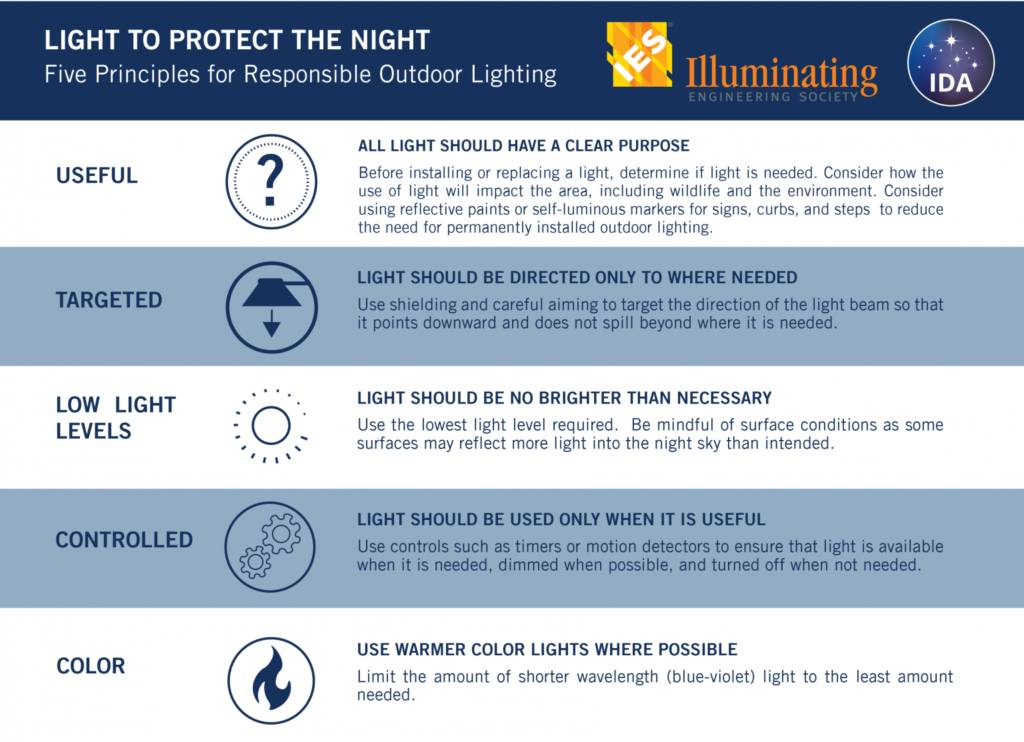
The International Dark-Sky Association (IDA) and the Illuminating Engineering Society (IES) have joined forces to address the global issue of light pollution. IDA and IES Board of Directors unanimously adopted Five Principles for Responsible Outdoor Lighting to guide the lighting industry to better, more sustainable lighting practices. These five principles are listed below:
-
Useful – All light Should have a clear purpose
-
Targeted – Light should be directed only to where necessary
-
Low Light Levels – Light should be no brighter than necessary
-
Controlled – Light should be used only when it is useful
-
Color – Use warmer color lights where possible
Good Lighting Practices
There are three main criteria one should consider whilst considering outdoor lighting:
-
The Light Fixture,
-
The Light Intensity (lumen level) and,
-
The Light color.
Go here for RESIDENTIAL LIGHTING PRODUCTS and here for COMMERCIAL LIGHTING PRODUCTS.